The Secret Ingredient to Baking Success: Mastering How to Measure Butter Like a Pro
Butter. It’s the golden heart of countless recipes, from flaky croissants to rich, chewy cookies and savory sauces that elevate a simple dish. But while butter’s role is undeniably star-studded, its proper measurement is often overlooked, leading to less-than-perfect results. Whether you’re a seasoned baker or just starting your culinary journey, knowing how to accurately measure butter is a foundational skill that can truly transform your kitchen triumphs. Forget imprecise guesswork and embrace the methods that guarantee consistent, delicious outcomes every time.
In this comprehensive guide, we’ll dive deep into the world of butter measurement, exploring tried-and-true techniques that cater to every kitchen scenario. We’ll cover everything from the simplest stick wrapper method to the precision of a kitchen scale and even ingenious hacks for when you’re caught without the right tools. Get ready to unlock the full potential of your baking and cooking by mastering this essential skill!
Why Accurate Butter Measurement Matters
Baking, in particular, is often described as a science, and for good reason. Unlike cooking, where a pinch of this or a dash of that can often be forgiven, baking relies on precise ratios. Butter, as a key player, significantly impacts texture, flavor, and structure. Too much, and your cookies might spread too thin; too little, and your cake could be dry and crumbly. Understanding why precision is paramount is the first step to becoming a truly confident home chef.
The Science of Baking
Butter brings much more than just flavor to the table. Its fat content provides tenderness and moisture, its milk solids contribute to browning, and its water content creates steam, which is crucial for leavening. When you cream butter and sugar, you’re incorporating air, which expands during baking to create a light, airy texture. Any deviation in the amount of butter can throw off this delicate balance, affecting everything from gluten development in breads to the spread of cookies and the flakiness of pie crusts. For delicate pastries or a perfect batch of beef wellington, precise measuring butter for baking is non-negotiable.
Volume vs. Weight
One of the biggest debates in the culinary world revolves around measuring by volume versus measuring by weight. While volume measurements (like cups and tablespoons) are common in many home kitchens, they can be highly inconsistent, especially for ingredients like flour or even butter. The way you pack an ingredient, its density, and even the humidity can alter a volume measurement. For example, softened butter might pack differently into a cup than very cold butter. This is why professional bakers and serious home cooks often gravitate towards weight measurements.
“In baking, weight is king. It’s the most accurate way to measure ingredients, ensuring your recipes turn out perfectly every single time. For ingredients like butter, which can vary greatly in density depending on its state, a scale is invaluable.”
Measuring by weight accounts for the true mass of an ingredient, irrespective of how tightly it’s packed or its physical state. This is a critical distinction when considering butter weight vs volume, especially for sensitive recipes. While we’ll cover various methods, always remember that a kitchen scale offers the ultimate precision.
Method 1: The Stick Wrapper Method (The Easiest Way)
For many home cooks, especially in the US, butter comes in convenient sticks, typically 1/4 pound (113 grams) each, with handy measurements printed right on the wrapper. This is by far the most straightforward way to measure butter when your recipe calls for amounts like “half a stick” or “4 tablespoons.”
Understanding the Lines
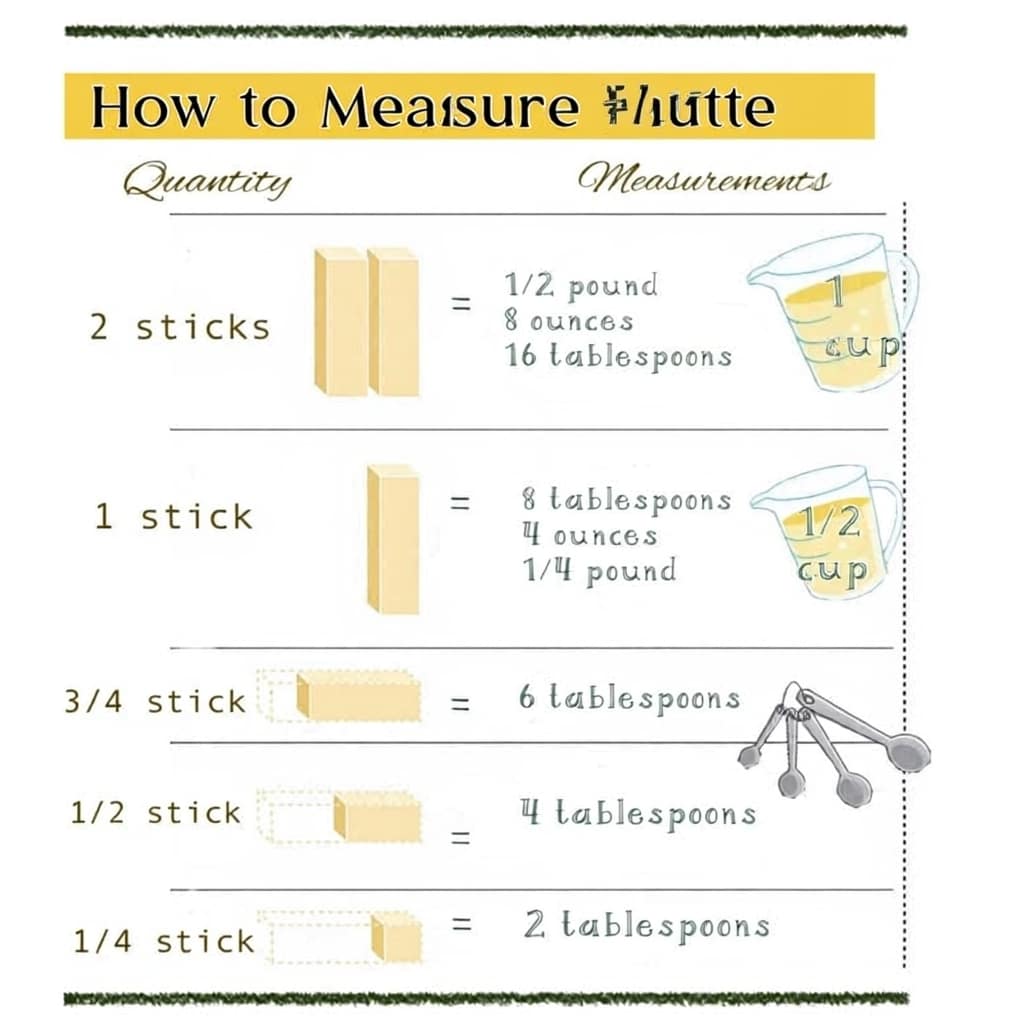
Most standard butter wrappers have markings indicating tablespoons and fractions of a cup. A typical stick of butter equals:
- 1/2 cup
- 8 tablespoons
- 4 ounces
- 113 grams
The lines often divide the stick into tablespoon increments (e.g., 1, 2, 3… 8 Tbsp) or quarter-cup increments (e.g., 1/4 cup, 1/2 cup). Simply locate the desired measurement on the wrapper and make your cut. This makes finding “1 stick of butter to cups” or tablespoons incredibly simple.
Tips for Clean Cuts
To get an accurate measurement using this method, especially with cold butter, precision is key. Here’s how:
- Keep it Cold: Cold butter is firm and easier to cut cleanly. If your butter is too soft, it might squash and distort your measurement lines.
- Use a Sharp Knife: A sharp, thin knife will slice through the butter smoothly without tearing the wrapper or smushing the butter.
- Cut Directly on the Mark: Align your knife precisely with the desired mark on the wrapper before cutting.
- Remove the Wrapper Last: Make your cut with the wrapper still on. This keeps the butter clean and contained, making it easier to handle the unused portion for storage.
This method is ideal for quick, everyday cooking and baking where extreme precision isn’t absolutely critical, but accuracy is still desired.
Method 2: The Kitchen Scale (The Professional Way)
If you’re serious about your baking or frequently encounter recipes that list ingredients by weight, a digital kitchen scale is your best friend. It offers unparalleled accuracy, eliminating the guesswork associated with volume measurements. This is especially true for measuring solid fats like butter, which can be dense and vary in consistency.
Why Weight is Best
As mentioned earlier, weight measurements are consistent. A gram of butter is always a gram of butter, regardless of whether it’s cold, softened, or even slightly melted. This consistency is crucial for replicating recipes precisely, ensuring that your homemade sourdough or delicate macarons turn out perfectly every single time. When a recipe calls for a specific number of grams in a stick of butter, a scale is the only way to get it exactly right.
How to Weigh Butter Cleanly
Weighing butter is incredibly simple and clean with a digital scale:
- Place a Bowl/Plate on the Scale: First, put an empty bowl, plate, or piece of parchment paper on your digital kitchen scale.
- Tare the Scale: Press the “tare” or “zero” button to reset the scale to zero. This ensures you’re only measuring the butter, not the container.
- Add Butter: Carefully place chunks of butter into the bowl or onto the parchment paper until you reach the desired weight. For cold butter, you might need to slice off pieces. For softened butter, you can scoop it.
- Adjust as Needed: Add or remove small amounts until the display shows the exact weight required.
This method is not only precise but also incredibly efficient, especially when dealing with large quantities or unusual measurements that don’t align with stick wrapper markings.
Method 3: The Water Displacement Method
What if you don’t have a kitchen scale and your butter isn’t in a stick with wrapper markings? Perhaps you have a large block of butter, or you need to measure butter without scales for an unusual amount. The water displacement method is a clever workaround that utilizes the principle that butter, being a solid fat, displaces liquid equal to its volume.
When to Use This Method
This technique is perfect for situations where you need to measure a specific volume of butter (e.g., 1/2 cup) but don’t have measuring cups designed for solids, or your butter block makes the wrapper method impossible. It’s particularly useful for cold, hard butter that’s difficult to pack accurately into a dry measuring cup.
Step-by-Step Guide
Here’s how to use the water displacement method butter measurement:
- Choose a Liquid Measuring Cup: Select a clear liquid measuring cup (like a Pyrex cup) with clearly marked increments.
- Add Water: Fill the measuring cup with water to a level that is *below* your desired butter measurement. For example, if you need 1/2 cup of butter, fill the cup to the 1/4 cup mark.
- Note the Initial Volume: Read and remember the exact water level. Let’s say it’s 1/4 cup.
- Calculate Target Volume: Determine your target total volume. If you need 1/2 cup butter, and you started with 1/4 cup water, you’ll need the total volume to reach 3/4 cup (1/4 cup water + 1/2 cup butter = 3/4 cup total).
- Submerge Butter: Carefully add pieces of butter to the water in the measuring cup. Push the butter down until it’s fully submerged beneath the water level.
- Read the New Level: Continue adding butter until the water level reaches your target total volume (e.g., 3/4 cup in our example). The amount of butter you’ve added is precisely the volume you needed.
- Remove Butter: Drain the water and remove your perfectly measured butter.
This technique might seem a bit unusual at first, but it’s remarkably effective and accurate for volume measurements.
Method 4: Packing Method (For Softened Butter)
For recipes that specifically call for softened butter, the packing method using dry measuring cups is a common and acceptable way to measure butter. This is typically used when you need to cream butter with sugar or incorporate it into a batter.
Using Dry Measuring Cups
Unlike liquid measuring cups, which have a spout and are designed to be filled to the brim, dry measuring cups are meant to be leveled off. To use them for softened butter:
- Scoop in Butter: Use a spoon or spatula to scoop the softened butter into the dry measuring cup.
- Pack Firmly: Press the butter down firmly against the bottom and sides of the cup to remove any air pockets. This is crucial for an accurate measurement.
- Level Off: Once the cup is full and firmly packed, use a straight edge (like the back of a knife or a bench scraper) to level off the top of the butter flush with the rim of the cup.
Avoiding Air Pockets
The biggest pitfall with the packing method is the inclusion of air pockets. If you don’t pack the butter down firmly, you’ll end up with less butter than the recipe calls for, which can impact the final texture of your baked goods. Imagine making a rich beef stew; you wouldn’t want to skimp on the flavor-enhancing fats! Similarly, ensure you’re truly filling the space with butter, not air. This method is generally accurate enough for most recipes calling for softened butter, but remember a scale always offers superior precision.
Ultimate Butter Conversion Chart
To make your life even easier, here’s a handy butter conversion chart for quick reference. Keep this guide bookmarked or print it out for your kitchen!
Quick Reference Guide
This table covers common conversions you’ll encounter in recipes:
| Measurement | US Stick Equivalents | Grams (approx.) | Ounces (approx.) | Tablespoons (Tbsp) |
|---|---|---|---|---|
| 1/4 cup | 1/2 stick | 57g | 2 oz | 4 Tbsp |
| 1/2 cup | 1 stick | 113g | 4 oz | 8 Tbsp |
| 3/4 cup | 1 1/2 sticks | 170g | 6 oz | 12 Tbsp |
| 1 cup | 2 sticks | 227g | 8 oz | 16 Tbsp |
| 1 Tbsp | – | 14g | 0.5 oz | – |
Metric vs. Imperial Conversions
Many international recipes use metric measurements (grams), while US recipes often use imperial (cups, tablespoons, sticks). This chart bridges that gap, making it easier to follow recipes from around the globe. Always remember that butter density can vary slightly, so these gram and ounce conversions are approximate but very close. This chart is your go-to whenever you need to know how many grams in a stick of butter or convert 1 stick of butter to cups quickly.
Frequently Asked Questions
Measuring Semi-Melted Butter
Q: How do I measure butter that’s semi-melted or mostly melted?
A: When butter is semi-melted or mostly melted, it’s best to measure it by weight using a kitchen scale for accuracy. If you don’t have a scale, you can measure it by volume using a liquid measuring cup. Pour the melted butter into the liquid measuring cup to the desired line. Be aware that melted butter’s density is different from solid butter, so a volume measurement might not be perfectly equivalent to a solid volume measurement, especially in precise baking. For best results, allow it to cool slightly if specified in the recipe, or re-solidify if the recipe calls for solid butter.
Salted vs. Unsalted Weights
Q: Does the weight of salted butter differ from unsalted butter?
A: No, for practical kitchen purposes, the weight of salted butter does not significantly differ from unsalted butter. While salted butter contains a small percentage of salt (typically 1.5% to 2% by weight), this amount is negligible enough that it won’t affect the overall weight measurement for recipes. One stick of salted butter will still weigh approximately 113 grams, just like a stick of unsalted butter.
Handling Cold Hard Butter
Q: What’s the best way to measure cold, hard butter when a recipe calls for softened butter?
A: If a recipe calls for softened butter but you only have cold, hard butter, it’s best to let it come to room temperature naturally for 30-60 minutes, or you can speed up the process by cutting it into smaller pieces. For precise measurement, use a kitchen scale or the stick wrapper method while it’s still cold and firm, then allow the measured amount to soften. Avoid microwaving butter to soften it if you need a specific consistency for creaming, as it can melt unevenly and alter the texture significantly, impacting the final result of your dish.
Mastering how to measure butter is a crucial step towards becoming a more confident and successful cook and baker. With these methods and your handy conversion chart, you’ll be well-equipped to tackle any recipe that comes your way, ensuring delicious results every time. Happy baking!
P.S. Craving more expert tips, delicious recipes, and kitchen hacks? Follow our culinary adventures and connect with fellow food enthusiasts! We’d love to see you there!
Follow us on Facebook: https://www.facebook.com/profile.php?id=61568538666337
4 Ways to Measure Butter Accurately
Ingredients
- Butter Cold or softened, depending on method used for the recipe found in the article body context or specific baking needs described herein or in the instru...
- 2 cups Cold Water Required specifically for the Water Displacement Method to measure irregular shapes
- 1 cup Ice Cubes Optional, helps keep water temperature low during displacement method
Instructions
- Method 1 (Wrapper): Locate the pre-marked tablespoon lines on the butter wrapper. Slice directly through the wrapper with a sharp knife at the desired mark (e.g., 4 tablespoons for 1/4 cup). Remove the wrapper from the cut portion.
- Method 2 (Scale): Place a small bowl or piece of parchment paper on a digital kitchen scale. Press the 'Tare' or 'Zero' button. Add butter pieces until the screen displays the exact weight required (e.g., 113g for 1 stick).
- Method 3 (Water Displacement): Fill a 2-cup liquid measuring cup with cold water exactly to the 1-cup line. Gently drop cold, irregular butter pieces into the water until the water level rises to the mark that indicates the total volume needed (e.g., if you need 1/2 cup of butter, add butter until the water reaches the 1.5-cup line). Drain the water while holding the butter back.
- Method 4 (Packing): Spoon softened butter into a dry measuring cup. Press down firmly with a spatula to eliminate air pockets. Level off the top with the straight edge of a knife.
For more daily recipes and tips, follow us on Facebook!
Click here to join our community!